
The Science Behind FllexiBott's 2-Stage Filtration
19/06/2026
When we say that FllexiBott filters water contaminants down to 0.2 microns, it may sound extremely small, but understanding just how small that size is makes the technology even more impressive.
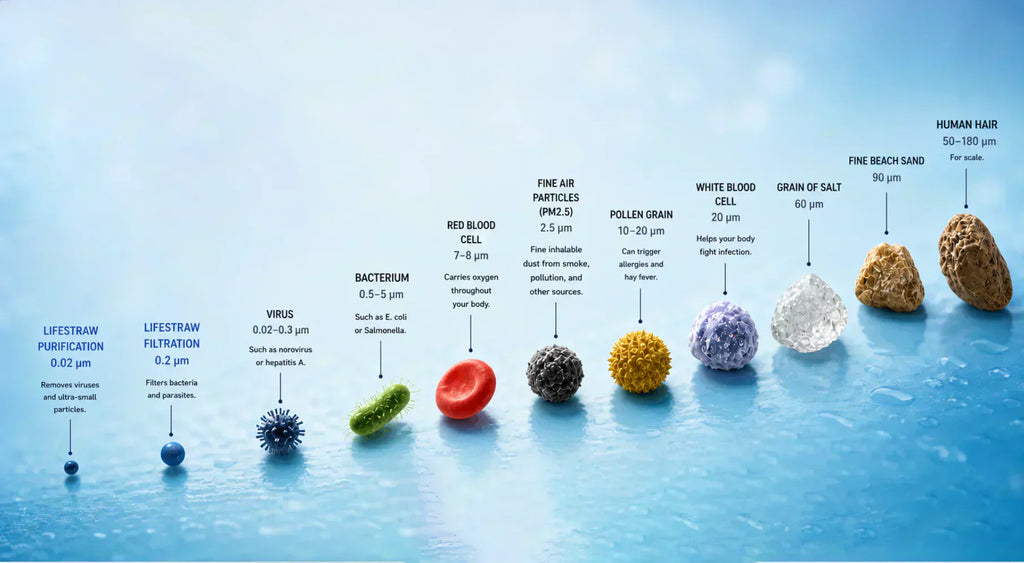
A micron, also known as a micrometer, is one-millionth of a meter. To imagine this better, a single human hair is usually around 70 microns wide. This means the pores inside a 0.2-micron FllexiBott filter are approximately 350 times smaller than the width of a human hair.
Even compared to things that are already microscopic, 0.2 microns is incredibly tiny. For example, red blood cells, which cannot be seen with the naked eye, are usually around 6 to 8 microns in diameter. That makes them about 30 to 40 times larger than the pores used in 0.2-micron filtration.
FllexiBott filtration is designed to help reduce common water contaminants such as bacteria, parasites, and microplastics, making everyday drinking water cleaner and safer for use.
Bacteria are one of the major causes of waterborne illness. Common bacteria such as E. coli are generally around 1 to 2 microns in size, which makes them much larger than 0.2 microns. Because of this size difference, bacteria are too large to pass through a properly designed 0.2-micron filter membrane.
Protozoan parasites are another serious concern in untreated or unsafe water. Organisms such as Giardia and Cryptosporidium can range from around 4 microns to more than 10 microns in size. Compared to a 0.2-micron pore, these parasites are many times larger, which allows the filter membrane to physically block them from passing through.
FllexiBott filtration works through hollow fiber membrane technology, a mechanical filtration method that uses thousands of tiny straw-like fibers. These fibers contain microscopic pores that allow water molecules to pass through while blocking larger unwanted particles.
As water moves through the filter, anything larger than the pore size, including bacteria, parasites, and many microplastic particles, is trapped on the outside of the membrane. This process is called mechanical filtration. It does not depend on chemicals, batteries, or complicated systems. Instead, it relies on precision engineering at a microscopic level.
Most bacteria and protozoan parasites are larger than 0.2 microns, which means they can be effectively reduced through this type of filtration process.
What About Viruses?
Viruses are much smaller than bacteria and parasites. Many viruses can measure between 0.02 and 0.3 microns, which means some may be small enough to pass through a standard 0.2-micron filter. Because of this, additional purification methods may be recommended in areas where viral contamination is a concern.
For stronger protection, advanced purification systems may use ultrafiltration technology with pores around 0.02 microns. This level of purification is around 10 times smaller than 0.2-micron filtration. To put that into perspective, 0.02-micron pores are approximately 3,500 times smaller than the width of a human hair and about 300 to 400 times smaller than an average red blood cell.
This is why there is an important difference between a filter and a purifier. A filter is mainly designed to reduce larger harmful contaminants such as bacteria, parasites, and microplastics. A purifier may provide an even finer level of protection, especially where smaller contaminants such as viruses may be a concern.
Ultimately, FllexiBott’s filtration approach is based on a smart balance of science and usability. The pore size must be small enough to block harmful contaminants, yet efficient enough to allow water to flow smoothly.
Clean drinking water is not only about making water look clear. It is about reducing invisible threats that may cause illness. With microscopic filtration technology, FllexiBott helps bring safer, cleaner, and more reliable drinking water into everyday life.
-
Posted in
athletics, clean water, environment